


Living With Grief
Grief is not something we can simply complete or leave behind. It becomes part of our lives, it can be messy, painful, and changing shape as time passes.
There is no correct way to grieve and it follows no routine. Some days may feel manageable, while other days can bring the pain back with unexpected force. Whatever you are feeling, you do not have to rush or pretend to be all right.
Understanding Grief
Grief is a response to losing someone we love deeply. It can affect our emotions, thoughts, physical health, relationships, and our ability to manage everyday life.
We may experience several emotions at the same time. There may be sadness, anger, confusion, guilt, fear, relief, numbness, and disbelief. None of these feelings means that you loved the person any more or less.
Grief does not follow a set pattern or a straight line. It is non-linear. It can come at any time, sometimes without warning.
It can come in waves, and there may be days when you feel as though you are moving backwards. This does not mean that you are failing. It is simply part of learning to live with a loss that has changed your life.
Different Experiences of Grief
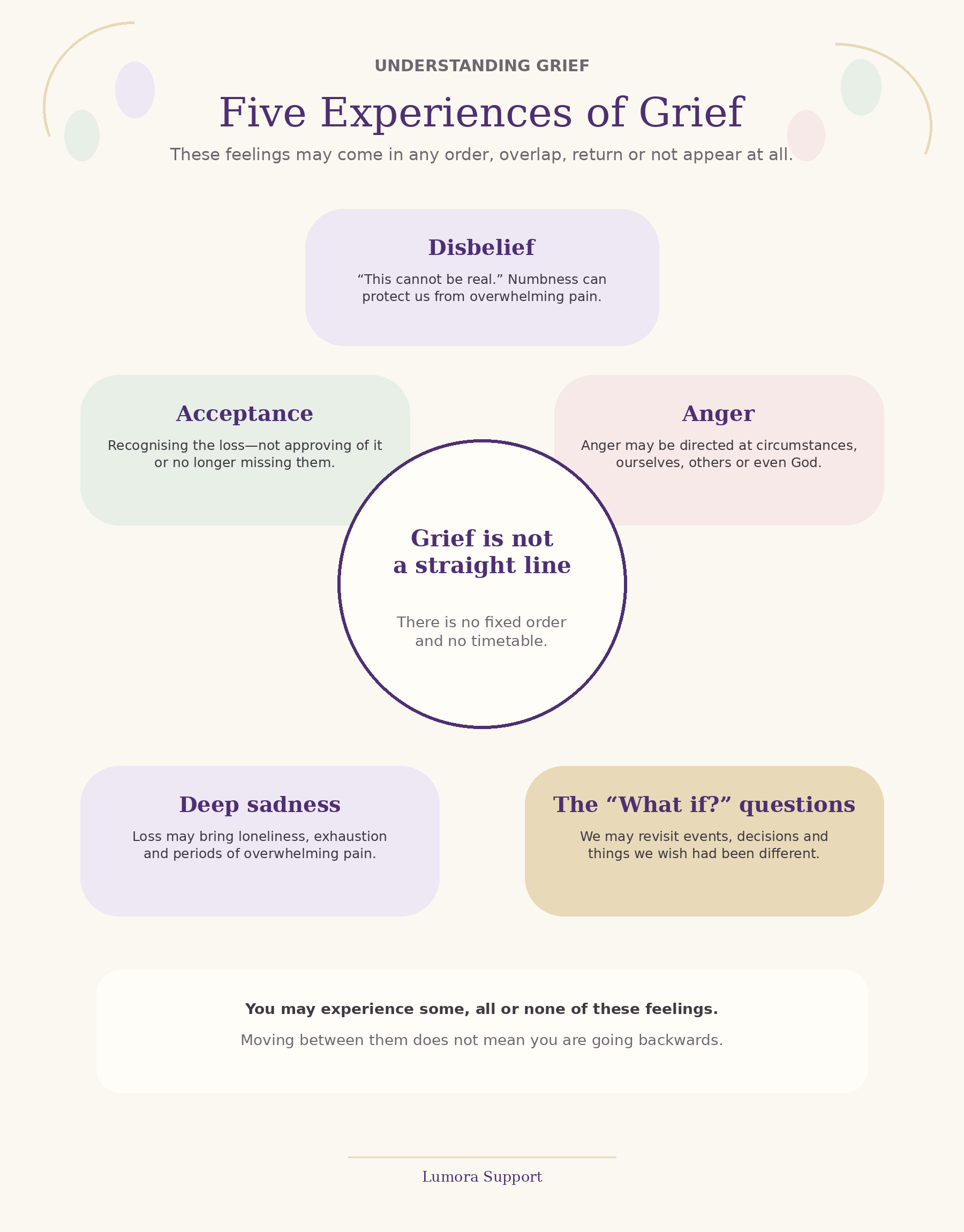
Adapted from the framework introduced by Dr Elisabeth Kübler-Ross in her 1969 book, On Death and Dying. These experiences are not a fixed sequence and may overlap, return or not occur at all.
The physical presence of someone we love may be gone, but the love we shared does not disappear. It can continue through our memories, the values they gave us, the lives they touched, and the ways in which they remain part of who we are.
Over time, grief may change. The relationship may change too — from one of physical presence to one carried through memory, love, and connection